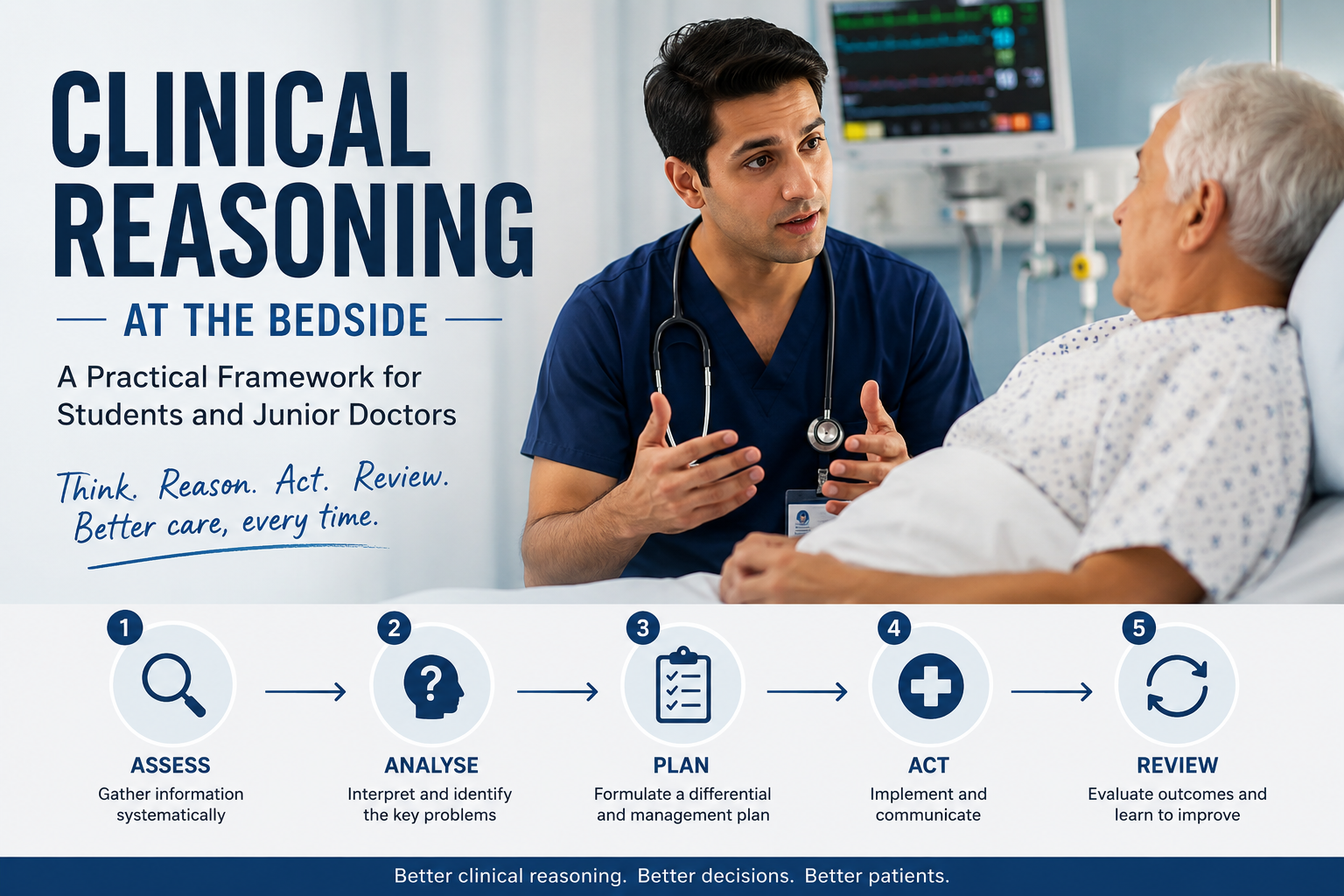
It is about learning to think clearly in the presence of uncertainty. At the bedside, the good clinician
does not merely collect symptoms and signs. He or she interprets them, prioritizes them, and builds a
structured explanation for the patient’s illness.
This process is called clinical reasoning.
For medical students and junior doctors, clinical reasoning often feels difficult because real patients do not
present like textbook summaries. They may have multiple diseases, incomplete histories, atypical features,
and conflicting investigation results. The challenge is to move from scattered information to a sensible
working diagnosis and a safe management plan.
What is clinical reasoning?
Clinical reasoning is the mental process used to gather clinical information, interpret its significance,
generate differential diagnoses, choose investigations, and make management decisions.
In simple terms, it means answering five important questions:
- What is the main problem?
- What are the dangerous possibilities?
- What is the most likely diagnosis?
- What evidence supports or argues against each possibility?
- What should be done next?
A mature clinician keeps all five questions active at the same time.
Start with the patient’s problem, not the label
A common mistake in early training is to jump too quickly to a diagnostic label. For example, on hearing
“shortness of breath,” a student may immediately think of asthma, heart failure, or pneumonia. But good
reasoning begins one step earlier.
First define the problem clearly.
Instead of writing:
“Patient has pneumonia.”
Try writing:
“An older man with 3 days of fever, productive cough, pleuritic chest pain, tachypnoea, and focal crackles
in the right lower zone.”
The second version is much better because it is based on observable clinical data. A diagnosis should emerge
from the problem representation, not replace it too early.
Build a problem representation
A problem representation is a brief summary that captures the essential features of the case.
It should include:
- Age and sex
- Time course
- Key symptoms
- Important examination findings
- Relevant risk factors or comorbidities
For example:
“A 62-year-old man with diabetes presents with acute central chest pain of 2 hours duration associated with
sweating and vomiting.”
This single sentence is far more useful than a long unstructured history. It immediately frames the urgency,
the likely organ system, and the risk level.
Think in categories first
When the diagnosis is not obvious, it helps to think in broad categories.
For a patient with jaundice, categories may include:
- Pre-hepatic
- Hepatic
- Post-hepatic
For acute kidney injury:
- Pre-renal
- Intrinsic renal
- Post-renal
For altered consciousness:
- Metabolic
- Toxic
- Structural neurological
- Infectious
- Psychiatric
Categorical thinking prevents narrow reasoning and reduces the risk of missing important alternatives.
Always identify the dangerous diagnoses first
Clinical reasoning is not only about being correct. It is about being safe.
When a patient presents with a symptom such as chest pain, headache, or breathlessness, the first task is not
to find the commonest diagnosis. It is to exclude the most dangerous one.
Chest pain
- Acute coronary syndrome
- Aortic dissection
- Pulmonary embolism
- Tension pneumothorax
Headache
- Subarachnoid haemorrhage
- Meningitis
- Intracranial haemorrhage
- Temporal arteritis in the appropriate age group
Shortness of breath
- Acute severe asthma
- Pulmonary oedema
- Pulmonary embolism
- Pneumothorax
- Severe pneumonia
A safe doctor asks: “What must I not miss?”
Use supporting and opposing evidence
A strong differential diagnosis is not just a list. Each possibility should be tested against the clinical data.
For example, if considering heart failure:
- Evidence supporting it: orthopnoea, elevated JVP, basal crackles, peripheral oedema
- Evidence against it: clear lungs, normal JVP, no cardiomegaly, alternative stronger explanation
This habit improves the quality of your case presentations. Instead of saying,
“The differential diagnoses are pneumonia, pulmonary oedema, and pulmonary embolism,”
say:
Pneumonia is likely because of fever, productive cough, and focal chest signs. Pulmonary oedema is less likely
because there is no history of orthopnoea, no raised JVP, and no bilateral basal crackles. Pulmonary embolism
remains a possibility because of acute onset dyspnoea and pleuritic pain, though fever and purulent sputum
make infection more likely.
That is clinical reasoning.
Time course matters
Many students focus on the symptoms but neglect the time course. Yet time course is often diagnostically powerful.
Ask whether the illness is:
- Hyperacute
- Acute
- Subacute
- Chronic
- Relapsing
- Progressive
Examples:
- Sudden hemiparesis suggests stroke until proven otherwise
- Gradually worsening fatigue over months suggests a chronic systemic process
- Intermittent episodic wheeze suggests airway disease
- Fever with weight loss over weeks suggests chronic infection, inflammation, or malignancy
Time is a diagnostic clue.
Patterns are useful, but avoid pattern traps
Experienced clinicians often recognize illness patterns quickly. This is useful, but it can also be dangerous if
done uncritically.
For example:
- Fever + cough + focal crepitations may suggest pneumonia
- Tremor + weight loss + tachycardia may suggest thyrotoxicosis
- Polyuria + polydipsia + weight loss may suggest diabetes mellitus
Pattern recognition is efficient, but it must always be checked against the full picture. If something does not fit,
pause and reconsider.
Atypical presentations are common in older adults, immunocompromised patients, and those with multiple comorbidities.
Investigations should answer a question
Another common mistake is ordering investigations without a clear purpose.
Before requesting a test, ask:
- What am I trying to confirm or exclude?
- Will this result change management?
- Is this the most appropriate first test?
Good clinical reasoning leads to focused investigations.
For example:
- ECG in chest pain: to look for ischemia or arrhythmia
- Chest X-ray in dyspnoea: to assess pneumonia, pulmonary oedema, effusion, or pneumothorax
- Arterial blood gas in severe respiratory distress: to assess oxygenation, ventilation, and acid-base status
- Urine full report in suspected renal disease: to look for protein, blood, casts, or infection
Tests should support thinking, not replace it.
Reassess continuously
Clinical reasoning is not a one-time act. It is dynamic.
A diagnosis that seems likely at admission may become less likely after new findings appear. Good clinicians revise
their thinking when the patient’s condition changes or new evidence emerges.
Always ask:
- Has the patient improved as expected?
- Are there new symptoms or signs?
- Do the investigation results fit the working diagnosis?
- Have I overlooked a second problem?
Failure to reconsider is a major source of diagnostic error.
The role of clinical examination
In modern practice, there is sometimes a temptation to rely too heavily on investigations. But bedside examination
remains essential.
Examination helps to:
- Assess severity
- Localize disease
- Narrow differentials
- Detect complications
- Guide urgency of management
For example, in a patient with liver disease, the bedside examination may reveal jaundice, ascites, asterixis,
muscle wasting, or peripheral stigmata of chronic liver disease. These findings immediately shape the diagnostic
and management approach.
A clinician who examines well thinks better.
Present cases in a reasoning-based format
When presenting a patient, do not simply recite information. Organize it in a way that demonstrates thought.
A useful structure is:
- One-line summary
- Main clinical problems
- Most likely diagnosis
- Differential diagnoses
- Evidence for and against
- Immediate concerns
- Proposed investigations
- Initial management plan
This makes your presentation more professional and shows maturity in clinical thinking.
Common errors in clinical reasoning
Premature closure
Accepting a diagnosis too early without considering alternatives.
Anchoring bias
Becoming fixed on the first impression and failing to adjust when new data appear.
Availability bias
Overdiagnosing conditions that were recently seen or recently studied.
Confirmation bias
Looking only for evidence that supports your initial diagnosis while ignoring contradictory findings.
Over-investigation without clinical direction
Ordering broad panels of tests instead of focused investigations guided by the history and examination.
Recognizing these errors is the first step in avoiding them.
How to improve your clinical reasoning
Clinical reasoning improves with deliberate practice.
Useful methods include:
- Presenting cases aloud
- Writing short problem representations
- Justifying each differential diagnosis
- Asking “what else could this be?”
- Reviewing cases after the final diagnosis is known
- Discussing reasoning errors openly with teachers and colleagues
A very practical exercise is this:
After seeing a patient, write down:
- The main problem
- Three differential diagnoses
- The single most dangerous diagnosis not to miss
- The next three investigations
- The immediate management priorities
Doing this consistently will sharpen your diagnostic thinking.
Final thoughts
Clinical reasoning is the heart of clinical medicine. It connects knowledge to patient care. It transforms a
student who memorizes facts into a doctor who can interpret, prioritize, and act safely.
At the bedside, the goal is not merely to name a disease. The goal is to understand the patient’s problem,
recognize danger early, make sensible decisions, and remain willing to revise your thinking when new evidence appears.
That is the discipline of good medicine.